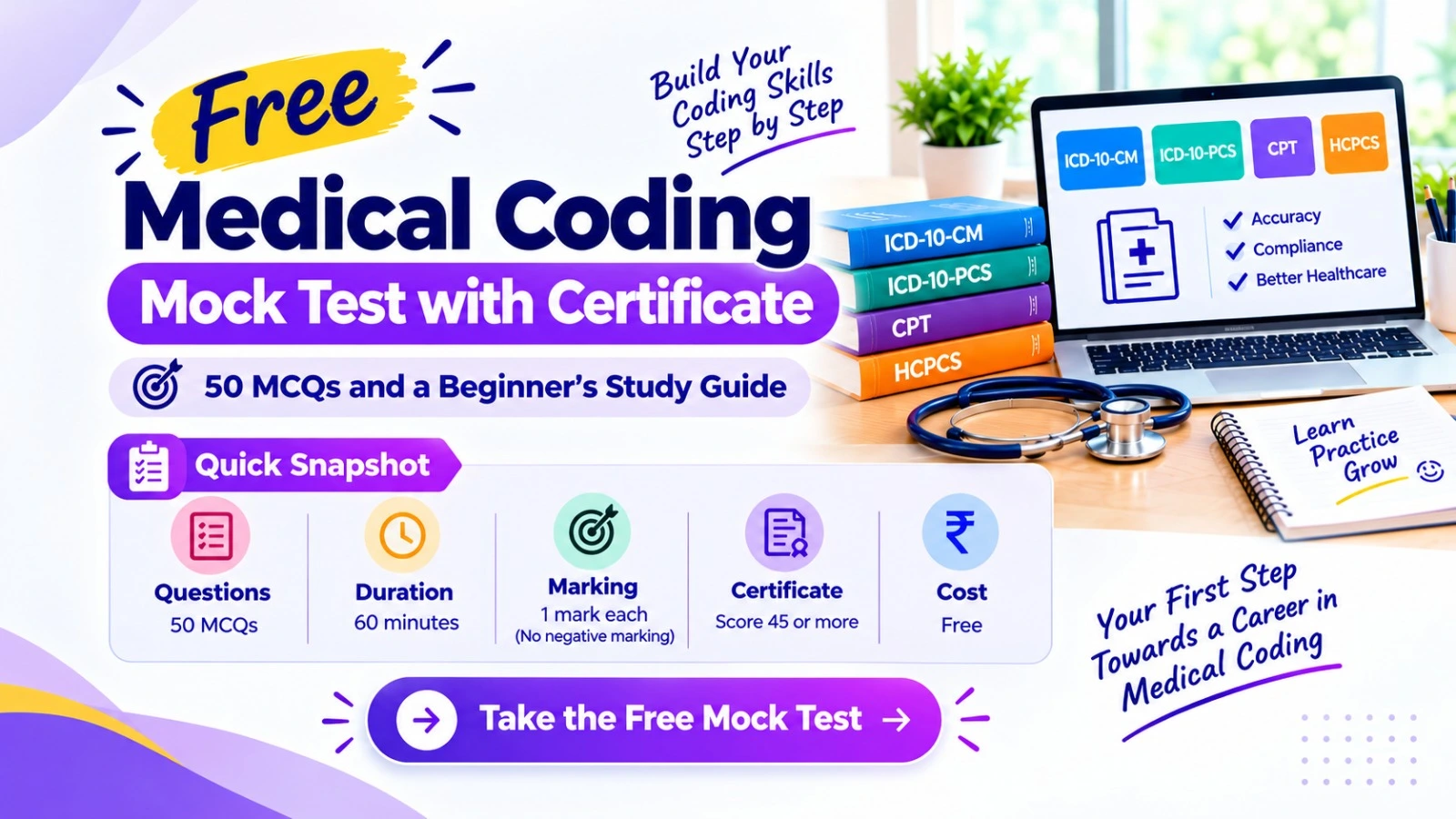
Free Medical Coding Mock Test with Certificate: 50 MCQs and a Beginner’s Study Guide
Published on: October 27, 2026 If you’re a pharmacy, life science or nursing graduate, someone has… Read More
Published on: November 3, 2026
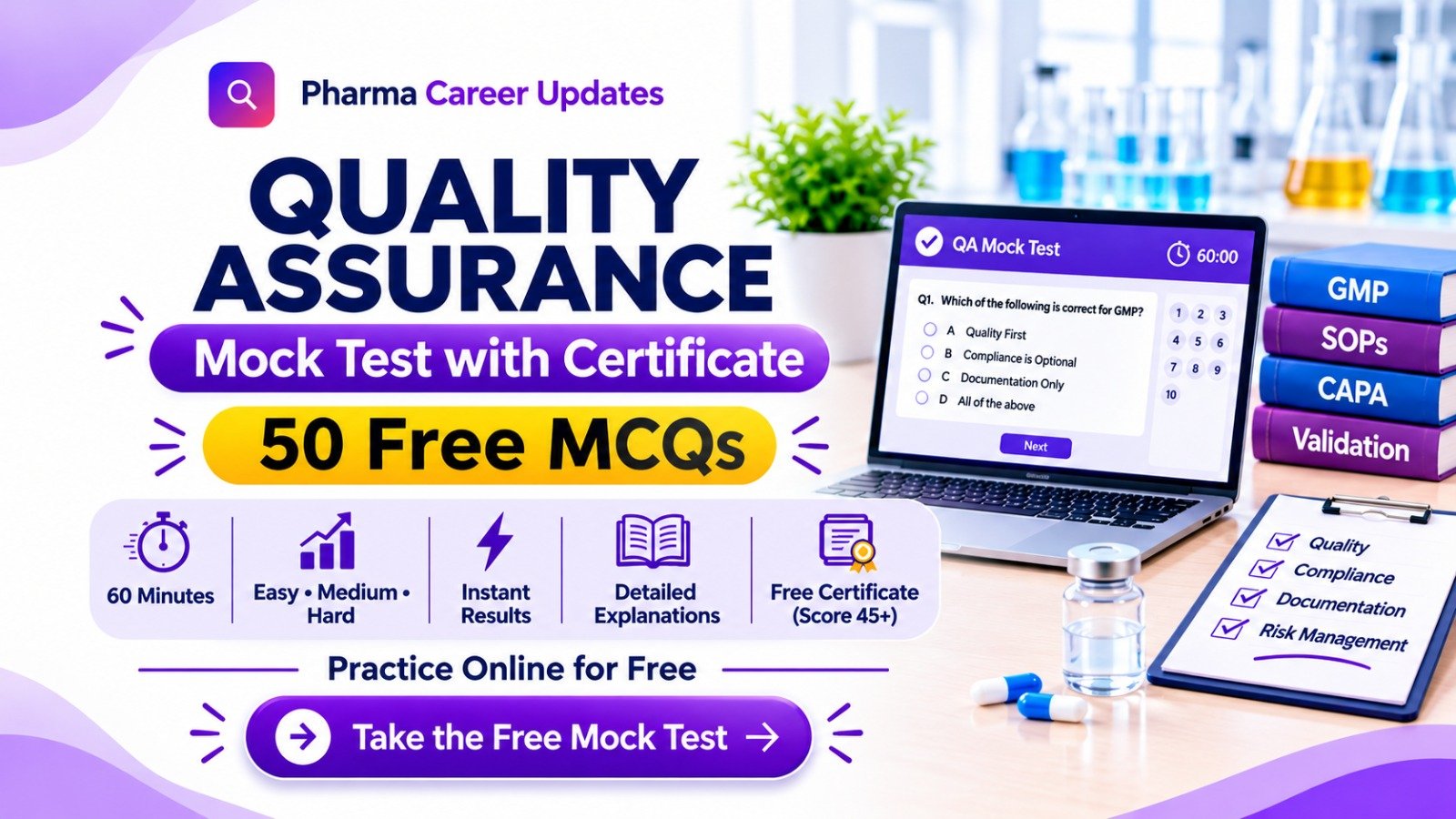
Getting ready for a pharma QA job can feel confusing. You read notes, watch videos and go through guidelines, but you still can’t tell how much you actually remember. That’s where practice helps. Our free Quality Assurance Mock Test lets you answer 50 real exam-style questions, see why each answer is right or wrong, and find the topics you need to study next.
In this guide, you’ll see how the test works, what you’ll learn from it, and where QA and QC careers can take you. Short on time? You can take the test right now, read about QA and QC roles and career growth in sections 4 and 5, check current openings in our QA/QC jobs section, or explore other roles in our pharma job categories.
| What | Details |
|---|---|
| Number of questions | 50 MCQs (15 Easy, 20 Medium, 15 Hard) |
| Time | 60 minutes with a live timer |
| Marks | 1 mark for each question |
| Negative marking | None |
| Result | Instant score and section-wise report |
| Answers | Explanation for every question |
| Certificate | Free, if you score 45 or more |
| Cost | Free |
👉 Ready? Start the Quality Assurance Mock Test here.
Many tests only give you a score. This one helps you learn from every attempt.
| Feature | How it helps you |
|---|---|
| Real exam screen with timer, question list and mark-for-review | You get used to a computer-based test before the real one |
| Easy, Medium and Hard sections | You can see if your basics or your tough topics need work |
| Answers stay hidden until you submit | Your score is honest, because you can’t peek |
| Explanation for every answer | You learn the reason, not just the right option |
| Separate tabs for correct, wrong and skipped questions | You can go straight to the questions where you lost marks |
| Questions and options change every time | When you retake it, you test your knowledge, not your memory |
| No negative marking | You can try every question without fear |
The 50 questions cover six topics. These come up often in QA interviews and audits. After you finish the test and read the explanations, you will be able to:
| Topic | What you’ll be able to do |
|---|---|
| GMP and documents | Explain what GMP, SOPs, BMR, MFR, CoA, line clearance, retention samples and Annual Product Review are used for |
| Validation | Know the types of validation, understand the FDA 2011 process validation lifecycle, and understand cleaning validation and MACO |
| Qualification | Put DQ, IQ, OQ and PQ in the right order and say what each one proves |
| Deviations and CAPA | Understand deviations, OOS, OOT and change control, and use tools like the Ishikawa diagram and Pareto chart to find root causes |
| Quality risk management | Understand ICH Q8, Q9 and Q10, plus Six Sigma and Cpk |
| Data integrity and utilities | Use ALCOA and ALCOA+, and answer questions on cleanroom grades, HEPA filters, WFI storage, TOC and endotoxin limits |
Want to read more while you practice? The official sources are a good place to start. For the rules, see FDA’s cGMP regulations (21 CFR Part 211). For validation, read the FDA process validation guidance. For risk management and quality systems, visit the ICH quality guidelines page. For data integrity, try FDA’s data integrity Q&A.
Many freshers apply to both, so let’s make it simple.
| QA (Quality Assurance) | QC (Quality Control) | |
|---|---|---|
| Main focus | The process and the system | The product and the sample |
| Way of working | Prevents problems | Tests and finds problems |
| Daily work | Checking documents, SOPs, batch records, deviations, audits | Testing raw materials, in-process samples and finished products in the lab |
| Work place | Plant floor and office | Mostly the laboratory |
| Good for people who like | Rules, paperwork, checking and problem-solving | Lab work, instruments and testing |
Common entry jobs:
| Job | What you do |
|---|---|
| QA Officer or Executive | Review documents, support audits, handle deviations and change control |
| IPQA (In-Process QA) | Check the manufacturing process on the shop floor |
| Documentation QA | Control SOPs, batch records and formats |
| QMS or Validation QA | Manage the quality system, qualification and validation work |
| QC Analyst or Chemist | Test samples in the lab and record the results |
| Microbiologist | Test for microbes in products, water and clean rooms |
QA is a good career because you can grow step by step, and you can choose the area you like best. The titles change from company to company, but a typical path looks like this:
| Stage | Typical role | What changes |
|---|---|---|
| Starting out | Trainee or QA Officer | You learn GMP, documents and daily checks |
| Early career | QA Executive | You handle deviations, change control and audits |
| Growing | Senior Executive | You lead investigations and guide juniors |
| Mid level | Assistant Manager or Manager | You manage a team and deal with auditors |
| Senior level | Senior Manager or Head of QA | You lead the quality system for a site or company |
As you gain experience, you can also move into related areas:
| Direction | What it means |
|---|---|
| Validation and qualification | Specialize in proving that equipment and processes work |
| Audits and compliance | Prepare for and run audits, including regulatory inspections |
| Quality investigations | Handle complex deviations and root cause analysis |
| Regulatory Affairs | Move into filing and approvals |
| When | What to do |
|---|---|
| Before the test | Look through the six topics in section 3, but don’t study too much. You want an honest first score |
| During the test | Follow the 60-minute timer. Use mark-for-review when you’re not sure |
| After the test | Open the wrong and skipped tabs first and read every explanation |
| Next | Study the topics where you lost marks, then take the test again |
| Your goal | Score 45 or more again and again |
When a wrong answer surprises you, go back to the basic steps. For CAPA, the steps are: deviation, investigation, root cause, corrective action, preventive action, and finally a check that the fix worked.
Score 45 or more out of 50 and you’ll get a Certificate of Achievement in Quality Assurance. It shows your name, college, qualification and score. It also has a unique number and a QR code, so anyone can scan it and check that it’s real.
You can download it as an image or PDF, add it to the Licenses & certifications section on LinkedIn, or attach it to your resume.
| If you are… | How it helps |
|---|---|
| A B.Pharm, M.Pharm or B.Sc/M.Sc student | Practice for QA and QC job applications |
| A fresher | A real test run before QA officer or executive interviews |
| Working in production or QC and want to move to QA | A quick check of the QA basics |
| Getting ready for a GMP audit or training test | A fast revision of the key points |
Will this test get you a job on its own? No. But it shows you what you know well and what you need to study, so you can prepare in the right places.
Not sure where to begin? Use this plan. It needs about an hour or two a day, and you can stretch it over two weeks if you’re busy.
| Day | What to do |
|---|---|
| 1 | Take the test with no preparation and note your weak topics |
| 2 | Revise GMP and documents: SOPs, BMR, MFR, CoA, line clearance |
| 3 | Revise validation and qualification, including cleaning validation |
| 4 | Revise deviations, OOS, OOT, change control and CAPA |
| 5 | Revise quality risk management: ICH Q8, Q9 and Q10 |
| 6 | Revise data integrity, ALCOA+ and utilities like cleanrooms and water systems |
| 7 | Retake the test, compare it with Day 1 and focus on what is still weak |
These questions come up again and again. Practice saying the answers out loud in your own words.
What is the difference between validation and qualification? Qualification proves that equipment, utilities or systems are fit for their intended use. Validation proves that a process, method or cleaning procedure consistently gives the expected result.
What is a deviation? It’s any departure from an approved procedure or specification. It must be recorded, investigated and closed.
What is the difference between OOS and OOT? An OOS (out of specification) result falls outside the approved limits. An OOT (out of trend) result is still within limits, but it looks unusual compared with past results, so it needs attention before it becomes a problem.
What is the difference between corrective and preventive action? A corrective action fixes a problem that has already happened. A preventive action stops a possible problem from happening in the first place.
What is change control? It’s a formal system for reviewing, approving and recording any change before it’s made, so the change doesn’t harm product quality.
What is line clearance? It’s a check that the area and equipment are free of the previous product, materials and documents before a new batch or activity starts.
What is data integrity? It means data is complete, consistent and accurate throughout its life. ALCOA+ is the set of principles used to check this.
| Short form | Meaning |
|---|---|
| GMP | Good Manufacturing Practice |
| SOP | Standard Operating Procedure |
| BMR | Batch Manufacturing Record |
| MFR | Master Formula Record |
| CoA | Certificate of Analysis |
| CAPA | Corrective and Preventive Action |
| OOS | Out of Specification |
| OOT | Out of Trend |
| MACO | Maximum Allowable Carryover |
| ALCOA | Attributable, Legible, Contemporaneous, Original, Accurate |
| WFI | Water for Injection |
| TOC | Total Organic Carbon |
For ALCOA+, add complete, consistent, enduring and available.
Once you’re done with QA, try our other free tests and stay updated through our channels.
| Resource | Link |
|---|---|
| Pharmaceutics mock test | Take the test |
| Pharmacology mock test | Take the test |
| Regulatory Affairs mock test | Take the test |
| Pharmacovigilance mock test | Take the test |
| Medical Coding mock test | Take the test |
| All free mock tests | See the full list |
| Job alerts and exam updates (WhatsApp) | Join on WhatsApp |
| Job alerts and exam updates (Telegram) | Join on Telegram |
In just 60 minutes, you’ll know where you stand. Start the Quality Assurance Mock Test now, and tell us your score in the comments. All the best!
Disclaimer: This article and the mock test are for educational and practice purposes only. They do not replace official guidelines, company SOPs or professional advice, and they do not guarantee any job, interview call or exam result. Job titles, roles and career paths vary between companies, so verify details from official sources and current job postings before making decisions.
Published on: October 27, 2026 If you’re a pharmacy, life science or nursing graduate, someone has… Read More
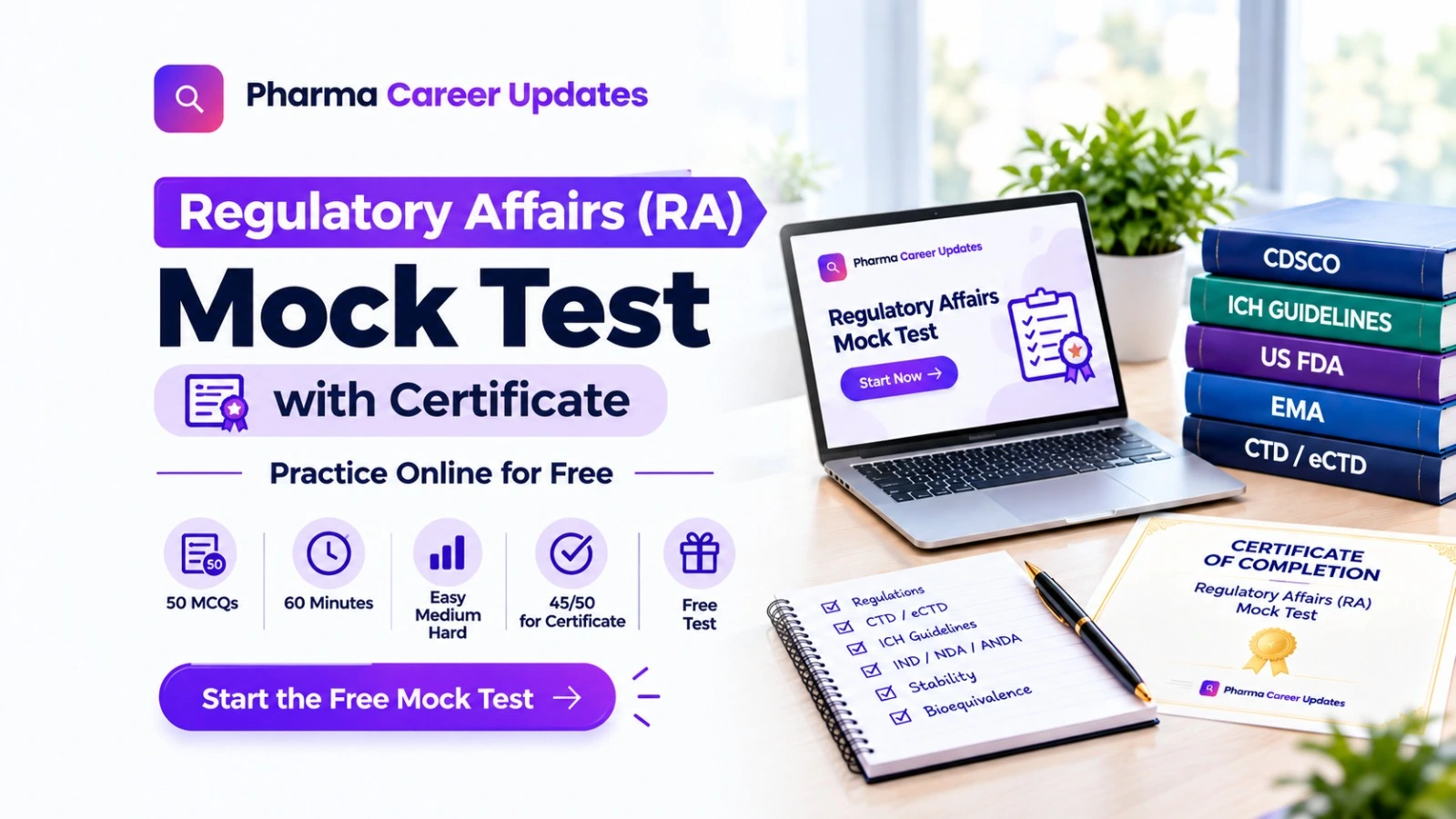
Regulatory Affairs (RA) Mock Test with Certificate – Practice Online for Free Published on: October 23,… Read More
Free Pharma Mock Tests
Test yourself on the subjects that matter for GPAT, pharmacist and pharma job exams.