Biocon Executive – GRA Emerging Markets Job in Bengaluru
Biocon Executive – GRA Emerging Markets Job in Bengaluru Published on: October 30, 2026 Biocon has… Read More
Published on: September 22, 2026
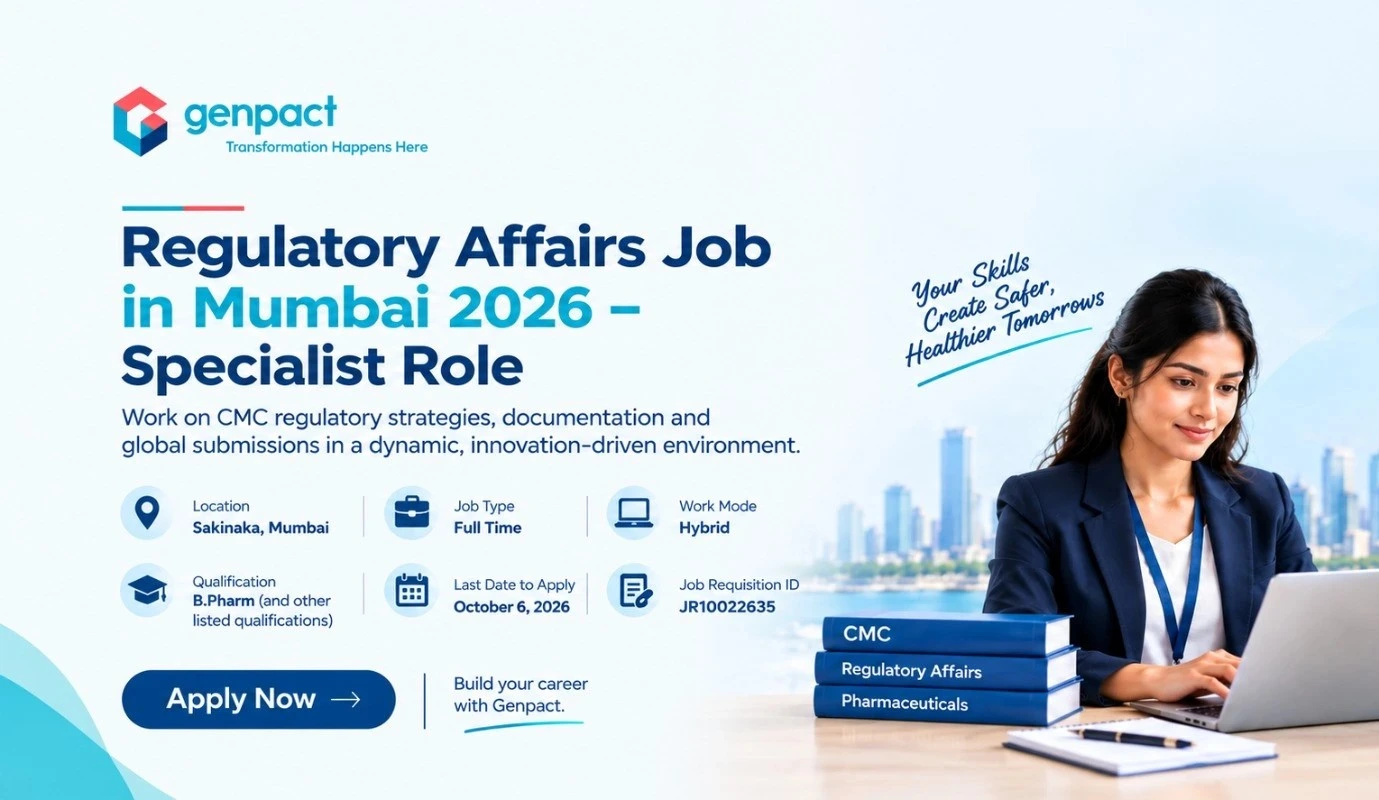
Genpact listed a Specialist – Regulatory Affairs – Operations 4A position in Sakinaka, Mumbai, under job requisition ID JR10022635. The role was full-time and hybrid, with Bachelor’s – Pharmacy included among the qualifications.
Status: Closed. Applications ended on October 6, 2026 (verified October 11, 2026). For similar roles, see our open Regulatory Affairs jobs or the Genpact Careers Portal.
| Details | Information |
|---|---|
| Company | Genpact |
| Position | Specialist – Regulatory Affairs – Operations 4A |
| Requisition ID | JR10022635 |
| Location | Raiaskaran Tech Park, Sakinaka, Mumbai |
| Work Mode | Hybrid |
| Job Type | Full-time / Regular |
| Shift | Day Job – India |
| Required Skill | Pharmaceutical Regulatory Affairs |
| Listed Pharmacy Qualification | Bachelor’s – Pharmacy |
| Original Application Deadline | October 6, 2026 |
| Current Vacancy Status | Closed (verified October 11, 2026) |
Details above are taken from the original vacancy listing on the official Genpact page.
The main area of work is CMC Regulatory Affairs.
CMC stands for Chemistry, Manufacturing and Controls. In pharmaceutical companies, this covers technical information about how a product is made, tested and controlled. For an overview of how CMC information is organized in regulatory submissions, refer to the ICH Common Technical Document (CTD) guidance.
For someone working in CMC Regulatory Affairs, that can mean dealing with information from different teams, checking whether the information is complete and helping prepare or maintain regulatory documentation.
The information may come from:
So, a person in this role needs more than basic knowledge of regulatory terminology. Understanding how pharmaceutical manufacturing and quality functions work is also useful.
Here is what the Genpact listing says this person would actually be doing:
| Area | What the work looks like |
|---|---|
| CMC strategy | Putting the regulatory strategy for assigned products into practice, in line with global rules and the plan already set for each product |
| Preparing dossiers | Putting together and reviewing the information needed for CMC dossiers of commercial products, covering both small molecules and biologicals |
| Writing CMC documents | Authoring documents for initial registrations and life-cycle submissions in different countries, working under the team’s scientists |
| Checking the science | Reading technical data carefully to see that it makes sense, is clearly presented and actually supports the conclusions |
| Chasing and tracking | Keeping work on schedule, following up with other teams for missing documents, and updating stakeholders on progress |
| Working with other teams | Understanding how manufacturing sites, QA and QC work, since this role depends on their data (prior experience there is a plus) |
| Improving processes | Helping update systems, SOPs and internal guidelines so the department runs better |
On top of this, the listing looks for someone who stays calm when priorities change, pays close attention to detail, communicates clearly in writing and in conversation, and is comfortable with advanced MS Office.
The exact day-to-day work depends on which products and projects the team is handling.
CMC Regulatory Affairs relies on technical information from several departments, and Regulatory Affairs turns it into the documents health authorities need.
| Department | Contribution |
|---|---|
| Manufacturing | Manufacturing process information |
| QC | Analytical data and product specifications |
| QA | Quality systems and compliance records |
| Regulatory Affairs | Regulatory documentation and submissions |
Experience in these functions helps candidates understand the technical information behind CMC work.
The Genpact listing mentions several systems and tools as preferred, not mandatory:
If you have worked with any of them, mention the experience clearly on your CV. If you haven’t, don’t add them just to match the job description.
Instead, highlight genuine experience with things such as:
For freshers, internship work, academic projects and dissertation work can also be used to demonstrate relevant skills.
| Level | Accepted degrees |
|---|---|
| Bachelor’s | Pharmacy, Healthcare, Health Administration |
| Master’s | Regulatory Affairs, Public Health |
| Language | English, proficient |
| Experience | Not stated in the listing |
The listing also named several certifications (CRCP, CRCM, CCO and CPA). It didn’t clearly make them mandatory.
| Candidate type | How well they would have fit |
|---|---|
| RA professionals | Strongest fit, especially with dossier or post-approval change experience |
| QA/QC professionals | Good fit, since they already know the data CMC documents depend on |
| M.Pharm candidates | Possible, with RA training or projects in formulation, analysis or quality |
| B.Pharm freshers | A stretch without hands-on documentation work; entry-level RA or QA roles are a safer start |
When a company applies to sell a medicine, it submits a dossier in a standard format called the CTD. The quality information (how the medicine is made, tested and controlled) goes into Module 3.
| Section | What it covers |
|---|---|
| 3.2.S | The active ingredient (drug substance) |
| 3.2.P | The finished product: formulation, manufacturing, specifications and stability |
The work doesn’t end when the product is approved. Companies change sites, processes and test methods, and most changes have to be assessed and reported to the health authority. This is what the listing calls “life-cycle management submissions”.
| Region | How changes are filed |
|---|---|
| EU | Variations (Type IA, IB and II) |
| US | Supplements (CBE-0, CBE-30 or PAS), depending on the risk of the change |
Stability data in these dossiers generally follows ICH Q1A(R2), and agency questions often come back to specifications, test methods or stability.
Example: moving tablet manufacturing to a new site
| Step | Who is involved |
|---|---|
| Work out what the change affects | Regulatory Affairs |
| Collect batch and stability data | Manufacturing, QA and QC |
| Check the data for gaps | Regulatory Affairs |
| Compile the filing for each country | Regulatory Affairs |
It’s detailed, coordination-heavy work, which is why the listing stresses attention to detail and follow-up with other teams.
| Question | Short answer |
|---|---|
| What goes into Module 3 of the CTD? | The quality information: 3.2.S for the drug substance and 3.2.P for the drug product. |
| What is a variation? | A change to an approved product that has to be assessed and, in most cases, filed with the health authority. |
| How would you check the regulatory impact of a change? | Find out exactly what is changing, compare it with what’s registered, classify the change, then work out the data and filing needed. |
| What is a DMF? | A confidential file an API manufacturer submits to the authority, which a product’s dossier can refer to. |
| Why does stability data matter? | It supports the shelf life and storage conditions of the product. |
| What would you do if QC was late sending data? | Raise it early, keep a record of your follow-ups, and tell stakeholders how the delay affects the timeline. |
| How do you make sure a document is accurate? | Check it against source data and the registered version, then get a second review. |
Interviewers often follow up with “tell me about a time when…”, so have a short real example ready for each answer. Freshers can draw on internships, projects or dissertation work.
Build your CV around documentation, careful data review, coordination and attention to detail, using real examples such as an SOP you wrote, a deviation you tracked or a project you kept on schedule.
| Common mistake | What to do instead |
|---|---|
| Listing tools you haven’t used (Veeva, SAP, LIMS) | Leave them off. It’s easy to be caught out in an interview. |
| Sending the same CV everywhere | Move your regulatory, documentation and data work to the top for each application. |
| Assuming a listed degree means you qualify | Read the whole job description before you apply. |
This role is closed. To find current openings, search the Genpact Careers Portal or see our open Regulatory Affairs jobs.
You may also like:
Important note: Genpact states that it does not charge fees for processing job applications. Be cautious if anyone asks you to pay money for an application, interview or job offer.
Is this job still open?
No. Applications closed on October 6, 2026 (verified October 11, 2026). You can find current openings on the Genpact Careers Portal.
Was B.Pharm eligible for this job?
Yes. Bachelor’s in Pharmacy was one of the accepted qualifications, along with Bachelor’s in Healthcare or Health Administration and Master’s in Regulatory Affairs or Public Health. For similar roles, always read the full job description, because a listed degree doesn’t mean you meet every requirement.
Where was the job located?
At Raiaskaran Tech Park, Sakinaka, Mumbai, Maharashtra. It was a hybrid role on a day shift.
Was this a CMC Regulatory Affairs position?
Yes. The role covered CMC regulatory strategy, dossier preparation, scientific review and project coordination for both small molecules and biologicals.
Could freshers apply?
The listing didn’t state a minimum experience. Even so, the role involves writing CMC documents and reviewing scientific data, so candidates with relevant internships, RA training or QA/QC exposure would have had a stronger case. If you are a fresher, look for entry-level RA roles and check the experience requirement before applying.
What is the last date to apply for similar Genpact jobs?
This varies by role. Check the closing information on each listing on the careers portal.
This Genpact vacancy closed on October 6, 2026, but it shows what CMC Regulatory Affairs teams look for. The work goes beyond preparing documents: you need to understand how products are made, tested and controlled, review technical data carefully, and keep several teams moving on the same timeline.
If you’re a B.Pharm or M.Pharm candidate aiming for roles like this, build your profile around that mix. Learn the basics of CMC and the CTD, get comfortable with documentation and Excel, and show real examples of coordinating work or checking data on your CV. Don’t list tools like Veeva, SAP or LIMS unless you’ve actually used them.
Ready to look for similar roles? Browse our open Regulatory Affairs jobs or read How to Start a Career in Regulatory Affairs After B.Pharm.
Biocon Executive – GRA Emerging Markets Job in Bengaluru Published on: October 30, 2026 Biocon has… Read More
Vigilare Biopharma Jobs: Pharmacovigilance, Regulatory Affairs & Medical Writing Published on: October 29, 2026 Vigilare Biopharma… Read More
Free Pharma Mock Tests
Test yourself on the subjects that matter for GPAT, pharmacist and pharma job exams.