Free Medical Coding Mock Test with Certificate: 50 MCQs and a Beginner’s Study Guide
Published on: October 27, 2026 If you’re a pharmacy, life science or nursing graduate, someone has… Read More
Published on: October 8, 2026
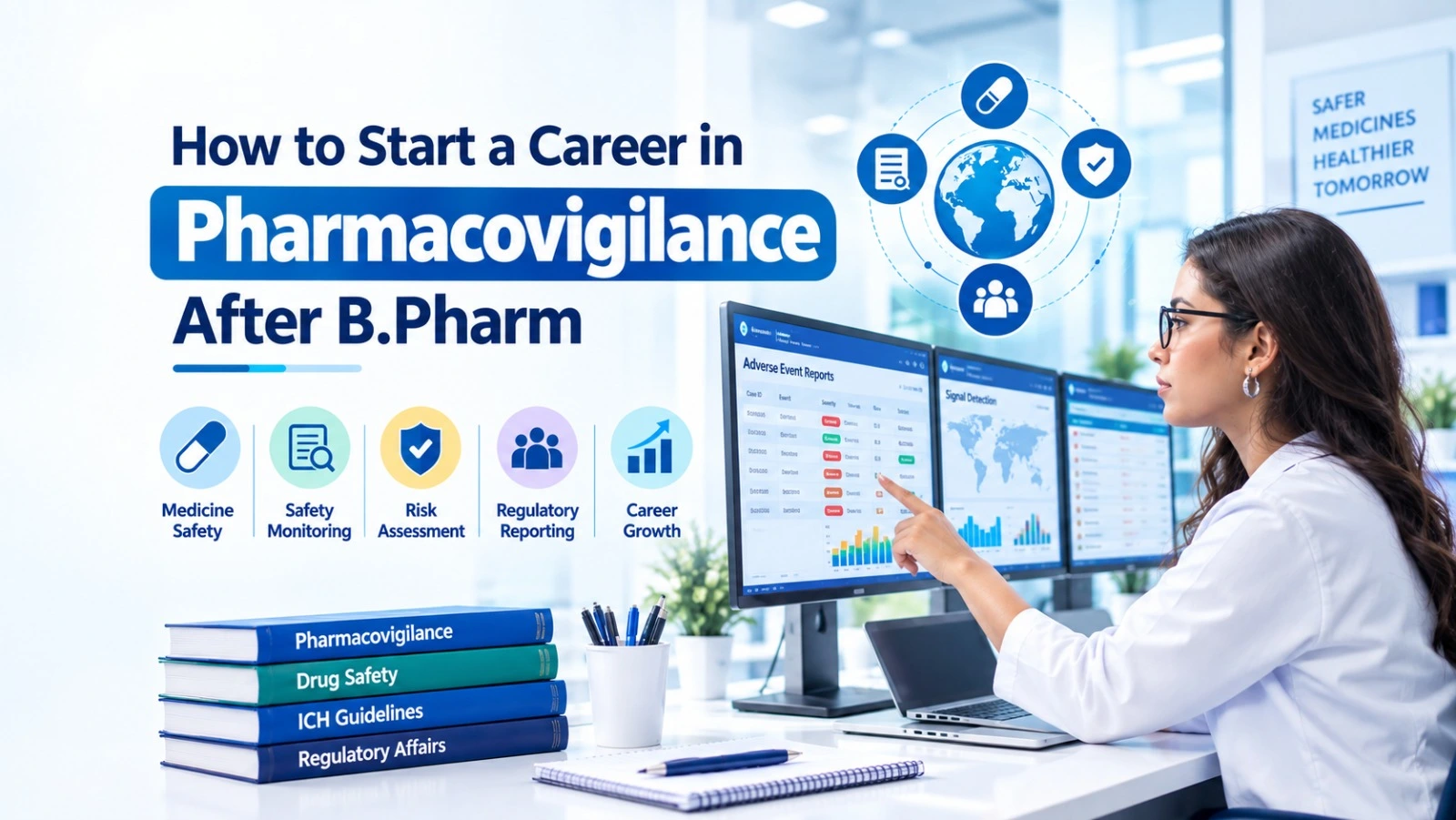
After B.Pharm, pharmacovigilance (PV) is a career option for graduates interested in medicine safety and adverse event monitoring. The field uses pharmacy knowledge, pharmacology, and medical terminology, with some entry-level roles open to B.Pharm graduates.
This guide covers PV roles, essential concepts and skills, and practical tips for starting your first pharmacovigilance job.
In simple terms, pharmacovigilance is the science and activities involved in detecting, assessing, understanding, and preventing adverse effects and other medicine-related problems. While medicines are tested before approval, additional safety information can emerge when they are used by larger populations. PV teams help collect, review, assess, and monitor this safety information.
The World Health Organization (WHO) pharmacovigilance page provides an overview of the field. In India, the Pharmacovigilance Programme of India (PvPI) operates under the Indian Pharmacopoeia Commission, while drug regulation is handled by the Central Drugs Standard Control Organisation (CDSCO).
For readers interested in broader pharmacy career options, you can also explore our guide on Career Options After B.Pharm.
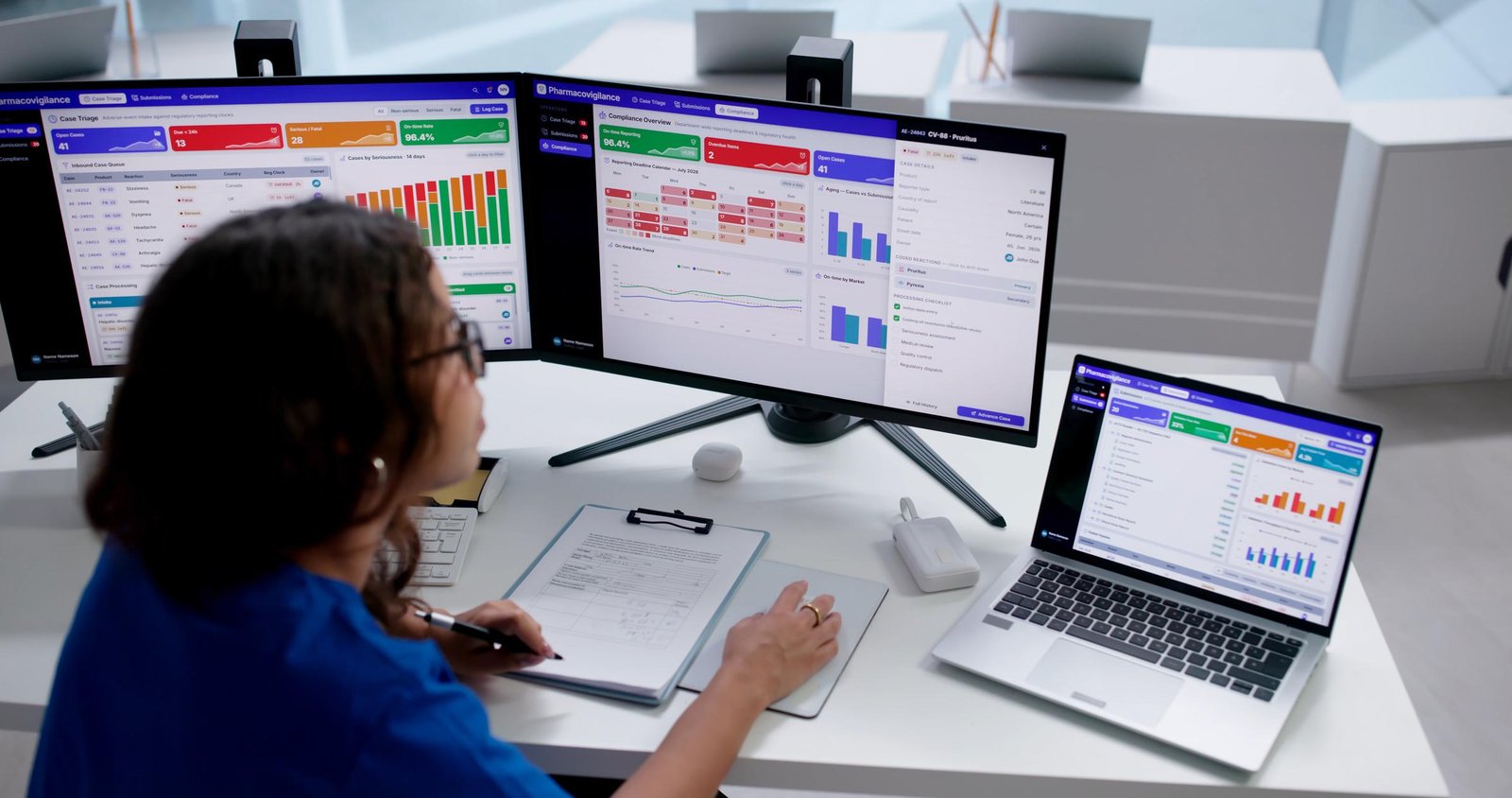
Yes, B.Pharm graduates can apply for some entry-level pharmacovigilance roles. However, eligibility varies by company and position. Some vacancies accept B.Pharm, while others may require M.Pharm, Pharm.D, life-science qualifications, or prior experience.
Always check the qualification, experience, skills, location, shift requirements, and deadline mentioned in the specific job description before applying.
Searching only for “pharmacovigilance jobs” can make you miss relevant openings because companies use different job titles.
| Job title | What the role may involve |
|---|---|
| Pharmacovigilance Trainee | Training and supervised safety-related activities |
| Pharmacovigilance Associate | Case processing, documentation and safety activities |
| Drug Safety Associate | Processing and reviewing drug-safety information |
| Case Processing Associate | Handling individual safety cases and related data |
| Safety Data Associate | Reviewing and maintaining safety information |
| Drug Safety Trainee | Entry-level training in drug-safety activities |
Responsibilities vary between companies, so always read the complete job description rather than judging a role by its title alone.
A large part of entry-level PV work involves Individual Case Safety Reports (ICSRs). An ICSR contains information about a suspected adverse reaction or other safety-related event associated with a medicinal product. Depending on the organization and project, an associate may:
Not every PV professional does all of these. Larger organizations may divide case-processing work between teams.
A doctor reports that a 45-year-old patient developed a skin rash and was admitted to hospital after starting “Drug X”.
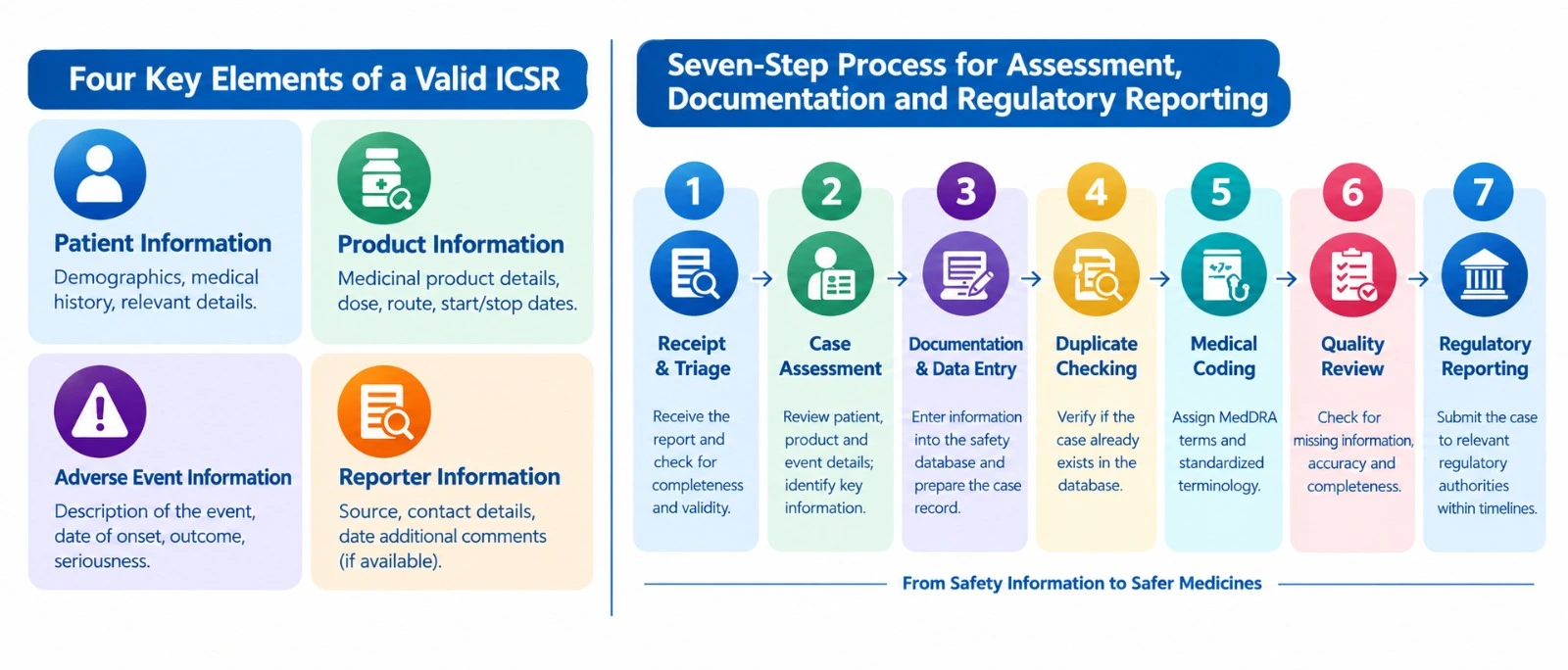
A valid ICSR generally contains four key elements and goes through a structured process involving case review, documentation, assessment, and regulatory reporting.
MedDRA is the Medical Dictionary for Regulatory Activities, a standardized medical terminology used for regulatory activities and safety reporting. In PV it helps code and classify medical information consistently in safety reports and databases. For freshers, understanding its purpose and basic use matters more than memorizing the full name. See the official MedDRA website.
For entry-level roles, it is important to understand the basic terminology and be able to explain these concepts clearly.
| Term | Simple explanation |
|---|---|
| Adverse Event (AE) | Any untoward medical occurrence in a patient who has received a medicinal product. It does not necessarily mean the medicine caused it. |
| Adverse Drug Reaction (ADR) | A harmful and unintended response to a medicine where a causal relationship is at least a reasonable possibility. |
| ICSR | An Individual Case Safety Report containing information about a suspected adverse event associated with a medicinal product. |
| Causality | Assessment of the relationship between a medicine and a reported event. |
| Expectedness | Whether the nature or severity of a reaction is consistent with the applicable reference safety information. |
| Seriousness | Whether an event meets defined regulatory criteria, such as death, hospitalization, or other medically important outcomes. |
| Severity | The intensity of an event, such as mild, moderate, or severe. |
| MedDRA | Standardized medical terminology used for regulatory activities, including safety information coding. |
This is a common interview topic, and the two terms should not be treated as synonyms.
| Point | Seriousness | Severity |
|---|---|---|
| Meaning | Refers to whether an event meets defined regulatory criteria | Refers to the intensity of the event |
| Examples | Death, hospitalization, disability or other medically important outcomes may meet seriousness criteria | Mild, moderate or severe describes intensity |
| Determined by | Regulatory criteria | Clinical intensity |
| Can they be the same? | No. A severe event is not automatically a serious event | A mild event can still meet a seriousness criterion in some circumstances |
The ICH E2A guideline covers key concepts for clinical safety data. More guidelines are on the ICH website.
A B.Pharm degree gives you a useful foundation, but employers also look for practical skills:
You do not need advanced technical skills for every entry-level role. Focus first on the requirements in the vacancy.
Start with the fundamentals and build gradually. A simple learning order:
PV basics → AE and ADR → ICSR → seriousness vs severity → causality → expectedness → MedDRA → case processing → basic regulatory concepts
Practise basic Excel alongside these topics. The aim is to understand the concepts clearly and know how they apply to actual PV work.
A pharmacovigilance certification is not mandatory for every entry-level role. A good course can help you build a structured understanding of PV concepts, case processing, and safety terminology, but it does not guarantee a job.
Before enrolling, check the syllabus, instructor background, practical content, learner reviews, and course updates. Avoid programs that promise guaranteed jobs or placements. A certificate is valuable only if you can apply and explain what you learned.
Search with several keywords: Pharmacovigilance jobs for freshers, PV Associate B.Pharm, Drug Safety Associate, Pharmacovigilance Trainee, Case Processing Associate, Pharmacovigilance jobs India. Check company career pages, established job portals, and verified recruitment channels.
| Check | What to look for |
|---|---|
| Qualification | Is B.Pharm accepted? |
| Experience | Are freshers eligible? |
| Location | Is the job location practical for you? |
| Shift | Are rotational or night shifts mentioned? |
| Skills | Do you meet the important requirements? |
| Deadline | Is the application still open? |
| Application source | Is it an official company or verified recruitment source? |
Whenever possible, apply through the company’s official careers page. Never pay anyone who claims payment is required to secure an interview or job.
Related reading: Career Options After B.Pharm
Your resume doesn’t need to look like an experienced PV professional’s. For a fresher, focus on what you can genuinely discuss:
Avoid listing software, databases, or skills you have never used. Writing “MedDRA expert” after a short introductory video can cause problems in an interview. “Basic understanding of MedDRA terminology” is better if that reflects your knowledge.
For fresher roles, interviews may cover pharmacy fundamentals as well as basic PV concepts. Prepare to explain:
Don’t rely only on memorized definitions. An interviewer may ask you to explain a concept using a simple example, as in the examples above.
Career progression varies by organization. A common path is Trainee/Associate → Senior Associate → Specialist → Lead → Manager. With experience, professionals can move into case quality review, literature surveillance, signal detection, compliance, aggregate reporting, and PV quality management. Entry-level experience can help you identify the area that suits you best.
PV and Regulatory Affairs are both possible career paths for pharmacy graduates, but the day-to-day work is different.
| Pharmacovigilance | Regulatory Affairs | |
|---|---|---|
| Main focus | Medicine safety | Regulatory requirements |
| Typical work | Safety cases, medical information and safety documentation | Submissions, dossiers and regulatory documentation |
| Useful interests | Medicines, adverse events and detailed data | Guidelines, submissions and structured documentation |
| Common entry work | Case processing and safety activities | Regulatory documentation and submission support |
Neither field is automatically better. The better choice depends on the type of work you enjoy.
If you are interested in medicine safety and adverse-event information, PV may be worth exploring. If you prefer regulatory guidelines, submissions, and product documentation, Regulatory Affairs may be a better fit.
Related reading: Career in Regulatory Affairs After B.Pharm
Yes. Some companies hire B.Pharm freshers for entry-level PV and drug-safety roles, depending on the job requirements.
It can be a good option if you are interested in medicine safety, documentation, and detail-oriented work.
Not always. Some jobs accept B.Pharm, while others ask for M.Pharm, Pharm.D, or relevant experience.
No. A certification is not required for every PV job. A good understanding of basic PV concepts is more important.
Start with PV basics, AE, ADR, ICSR, seriousness, severity, causality, expectedness, and MedDRA. Then learn the basics of case processing.
No. PV also includes literature review, signal detection, compliance, and quality activities.
Yes, it is possible. You may need to learn more about regulatory guidelines, submissions, and documentation first.
Pharmacovigilance is a practical career option for B.Pharm graduates interested in medicine safety and detail-oriented work. Start by learning basic PV concepts, understanding entry-level roles, preparing an honest resume, and applying for suitable vacancies. With experience, you can explore case processing, quality, compliance, and literature surveillance.
This article is for general educational purposes. Pharmacovigilance job requirements, eligibility criteria, responsibilities, and hiring practices vary by employer. Always verify the latest requirements through the official job posting or company careers page before applying.
Published on: October 27, 2026 If you’re a pharmacy, life science or nursing graduate, someone has… Read More
Regulatory Affairs (RA) Mock Test with Certificate – Practice Online for Free Published on: October 23,… Read More
Free Pharma Mock Tests
Test yourself on the subjects that matter for GPAT, pharmacist and pharma job exams.