Free Medical Coding Mock Test with Certificate: 50 MCQs and a Beginner’s Study Guide
Published on: October 27, 2026 If you’re a pharmacy, life science or nursing graduate, someone has… Read More
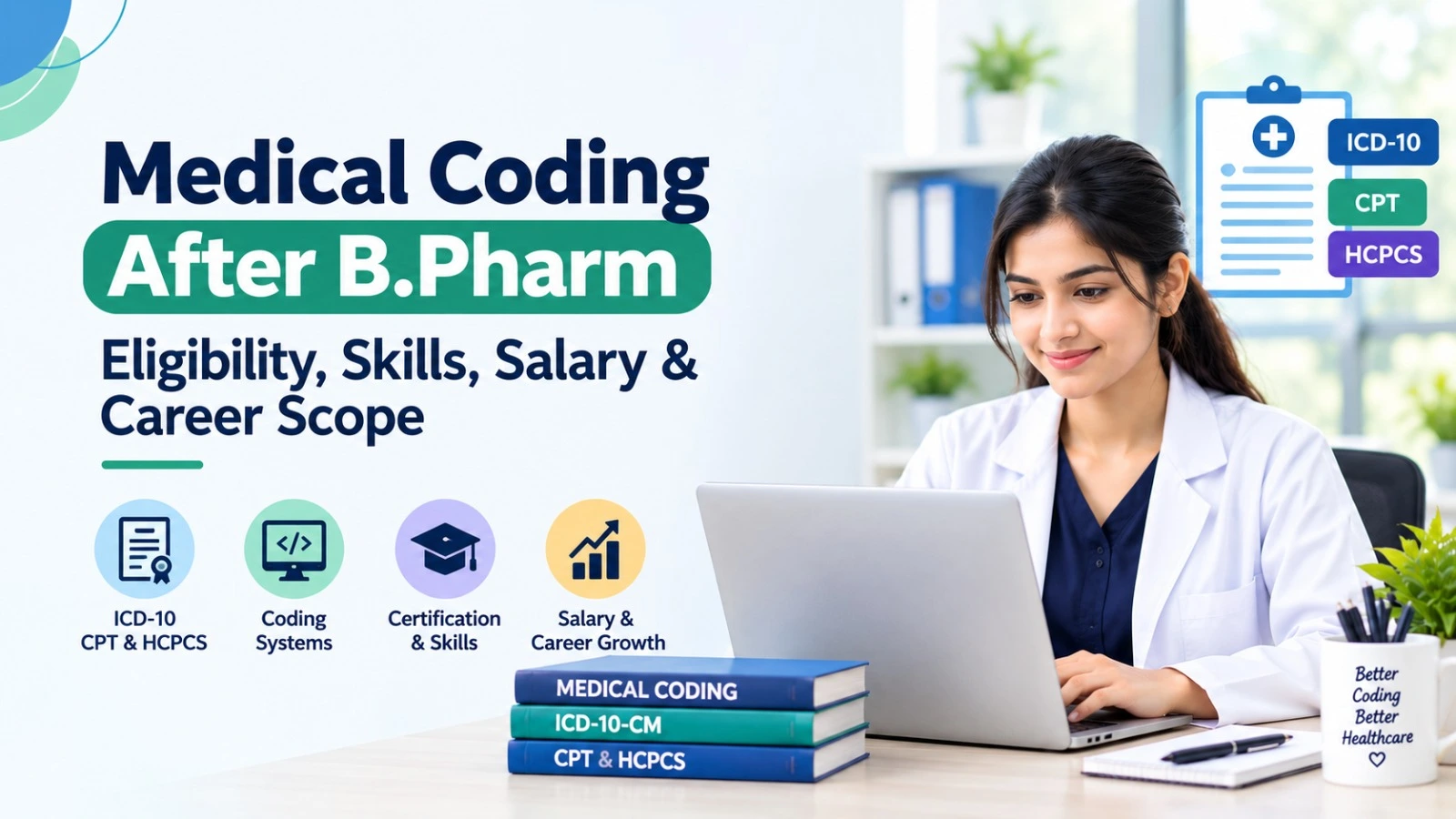
Published on: September 25, 2026
Medical coding is one of the healthcare career options that B.Pharm graduates can explore outside traditional pharmacy roles such as production, quality control, quality assurance and regulatory affairs.
The work mainly involves reviewing healthcare documentation and converting diagnoses, procedures and other clinical information into standardized medical codes.
For B.Pharm graduates, knowledge of medicines, diseases, medical terminology and basic healthcare concepts can be useful. However, medical coding also requires separate knowledge of coding systems, guidelines and documentation practices.
This guide explains medical coding after B.Pharm, eligibility, required skills, coding systems, certification, salary, career growth and preparation.
| Factor | Details |
|---|---|
| Educational Background | B.Pharm may be accepted for some entry-level positions |
| Main Work | Reviewing healthcare records and assigning appropriate medical codes |
| Useful Knowledge | Medical terminology, anatomy, physiology, diseases and medicines |
| Coding Systems | ICD-10-CM, CPT and HCPCS |
| Certification | Depends on the employer; CPC can be useful |
| Work Type | Mainly computer- and documentation-based |
| Career Growth | Medical coder, senior coder, quality, audit, specialized coding and healthcare operations |
Medical coding is the process of converting information from healthcare documentation into standardized codes.
A medical coder may review documentation related to:
The assigned codes are used in healthcare processes such as claims, reimbursement, reporting and documentation.
Accuracy is important because the code selected should be supported by the available documentation and applicable coding guidelines.
B.Pharm graduates already study several subjects that can provide a useful foundation for medical coding.
For example, pharmacy education involves:
However, pharmacy knowledge alone does not make someone a medical coder.
You still need to learn how coding systems work and how to apply coding guidelines to healthcare documentation.
For an overview of other career options, see our Career Options After B.Pharm guide.
The exact responsibilities depend on the employer and coding process, but a medical coder may be responsible for:
Some roles may focus on a particular specialty or coding process.
If you are interested in U.S.-focused medical coding, you will commonly come across these three coding systems.
| Coding System | Full Form | Mainly Used For | Official Resource |
|---|---|---|---|
| ICD-10-CM | International Classification of Diseases, Tenth Revision, Clinical Modification | Diagnoses and reasons for healthcare encounters | CDC |
| CPT | Current Procedural Terminology | Medical procedures and professional services | American Medical Association |
| HCPCS | Healthcare Common Procedure Coding System | Healthcare services, procedures, supplies and certain products | CMS |
You do not need to memorize every code before applying for an entry-level position. Understanding the purpose of each system and learning how to find and apply the correct code is more important.
Yes, some employers recruit freshers from pharmacy and other healthcare-related backgrounds.
However, eligibility varies from company to company.
A vacancy may ask for:
Some employers provide training to freshers, while others prefer candidates who already have medical coding knowledge.
Always check the qualification and experience requirements in the individual job posting.
Your pharmacy education provides a useful foundation, but coding-specific skills are also required.
| Skill | Why It Matters |
|---|---|
| Medical terminology | Helps understand healthcare documentation |
| Anatomy & physiology | Useful for understanding body systems and procedures |
| English comprehension | Important for reading medical records |
| Attention to detail | Helps reduce coding errors |
| Analytical ability | Helps interpret clinical documentation |
| Computer skills | Coding work is mainly computer-based |
| Coding guidelines | Helps with accurate code selection |
Good reading ability and attention to detail are particularly important because coding decisions depend on what is documented in the record.
Not every employer requires a separate medical coding course.
Some companies train freshers, while others prefer candidates who already have coding knowledge or certification.
If you decide to take a course, check whether it covers:
Avoid choosing a course only because it promises a guaranteed job or fixed salary.
The main purpose of the course should be to build practical coding knowledge that you can use when applying for jobs.
CPC certification can be useful for candidates who want to build a career in professional medical coding, but it is not automatically required for every medical coding vacancy.
Certification requirements vary by employer and position.
If you are considering CPC or another certification, check the current requirements directly with the certification provider before enrolling.
A practical approach is to build coding knowledge alongside the medical knowledge you already gained during B.Pharm.
Revise:
Understand the purpose and basic use of:
Read sample healthcare documentation and try to identify:
Once you have basic knowledge, search for positions such as:
You can also check our Junior Medical Coder Job article for an example of an entry-level opportunity.
If you are starting from the basics, you can structure your preparation like this:
| Days | Focus |
|---|---|
| 1–7 | Medical terminology and abbreviations |
| 8–14 | Anatomy, physiology and common diseases |
| 15–21 | ICD-10-CM, CPT and coding fundamentals |
| 22–26 | Documentation-based practice |
| 27–30 | Resume, interview preparation and job applications |
The timeline can be adjusted according to your existing knowledge and available study time.
There is no single salary figure for B.Pharm graduates entering medical coding.
Pay can vary based on:
Freshers generally start in entry-level positions. With experience, candidates may move into senior, quality, audit, specialized coding or healthcare operations roles.
It is better to compare the salary mentioned in actual job vacancies rather than relying on fixed salary promises from training institutes.
A possible career path is:
Trainee/Fresher → Medical Coder → Senior Medical Coder → Quality/Audit/Specialized Role → Team Lead or Healthcare Operations
The exact path depends on the employer, skills and area of specialization.
With experience, professionals may move into:
Medical coding is one of several career options available after B.Pharm.
| Career | Main Work | Typical Work Environment |
|---|---|---|
| Medical Coding | Healthcare documentation and coding | Computer-based |
| Quality Assurance (QA) | Quality systems and compliance | Office/manufacturing |
| Quality Control (QC) | Testing and analysis | Laboratory |
| Production | Pharmaceutical manufacturing | Manufacturing facility |
| Regulatory Affairs (RA) | Regulatory documentation and submissions | Documentation-based |
You can explore our guides on Career in Quality Assurance After B.Pharm and Career in Regulatory Affairs After B.Pharm if you want to understand these alternatives in more detail.
Medical coding may be suitable for B.Pharm graduates who:
Your pharmacy background can help with medical terminology and healthcare concepts, although coding itself requires additional learning.
Before choosing this field, understand the practical side of the work.
For a fresher interview, focus on understanding the basics rather than trying to memorize large numbers of codes.
Be prepared to explain:
You may also be asked:
“Why do you want to move from B.Pharm to medical coding?”
Prepare an honest answer that connects your pharmacy education with your interest in healthcare documentation and computer-based work.
Check these points before applying:
Never pay an individual to guarantee a job or interview.
Medical coding and medical billing are related but different.
Medical coding focuses on reviewing healthcare documentation and assigning standardized codes.
Medical billing is more closely related to claims, reimbursement and payment processes.
For a detailed comparison, see our Medical Coding and Medical Billing article.
Yes. Some employers accept B.Pharm and other healthcare-related graduates for entry-level medical coding positions.
Your degree may satisfy the educational requirement for some vacancies, but you will still need medical coding knowledge.
No. Certification requirements depend on the employer and position.
Yes. Some companies recruit freshers for trainee and junior medical coding positions.
Yes. Some India-based healthcare operations support U.S. clients and use U.S. coding systems.
Medical coding can be an option for B.Pharm graduates who are interested in healthcare documentation and computer-based work.
Start by understanding the basic coding systems, practise with documentation-based cases and then look for entry-level vacancies that match your qualification.
Before paying for a course or certification, check current employer requirements and understand what the job actually involves.
Note: Eligibility, certification, salary, location, shifts and application procedures can vary by employer. Verify the latest details in the specific job notification or company career page before applying.
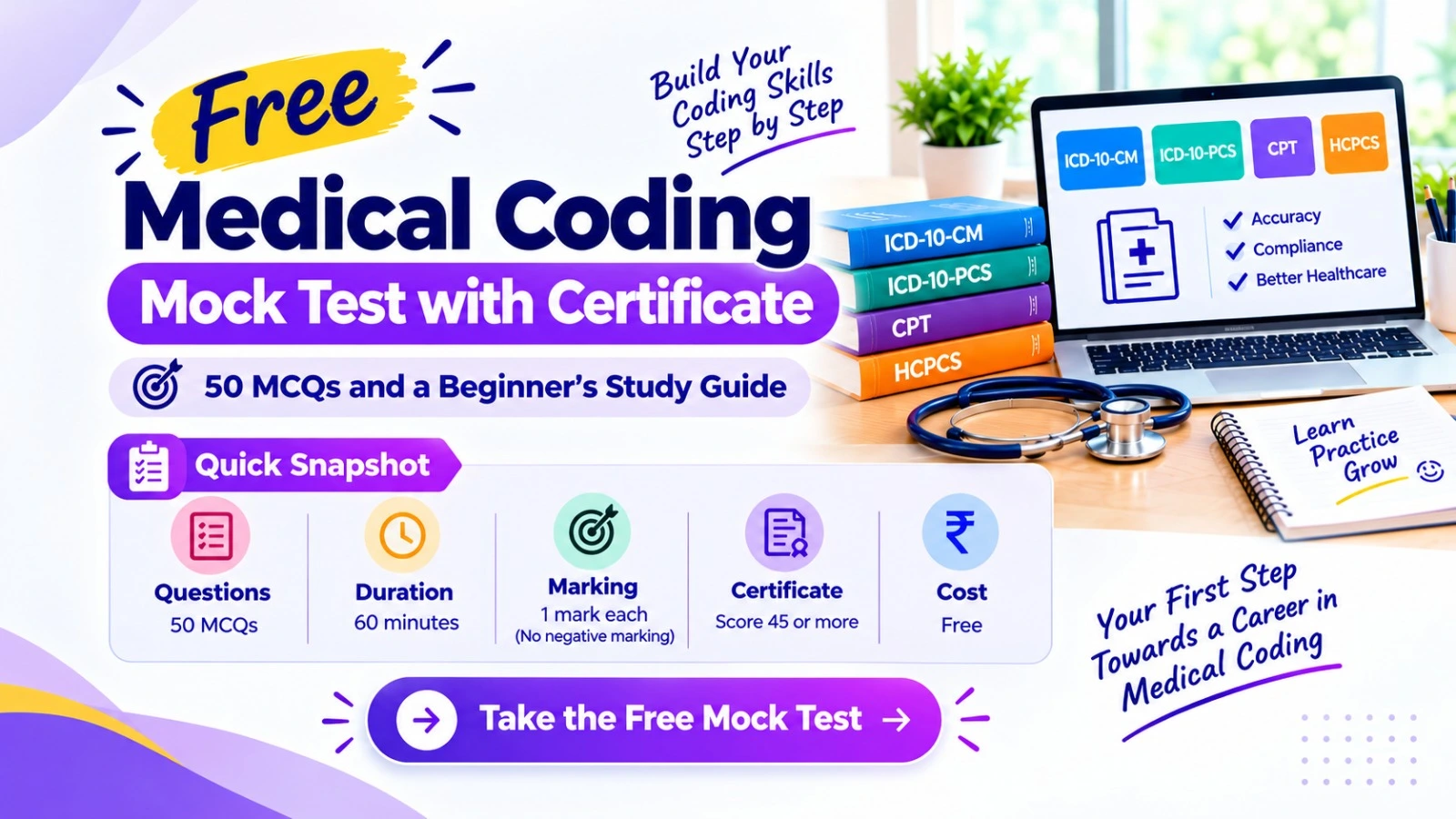
Published on: October 27, 2026 If you’re a pharmacy, life science or nursing graduate, someone has… Read More
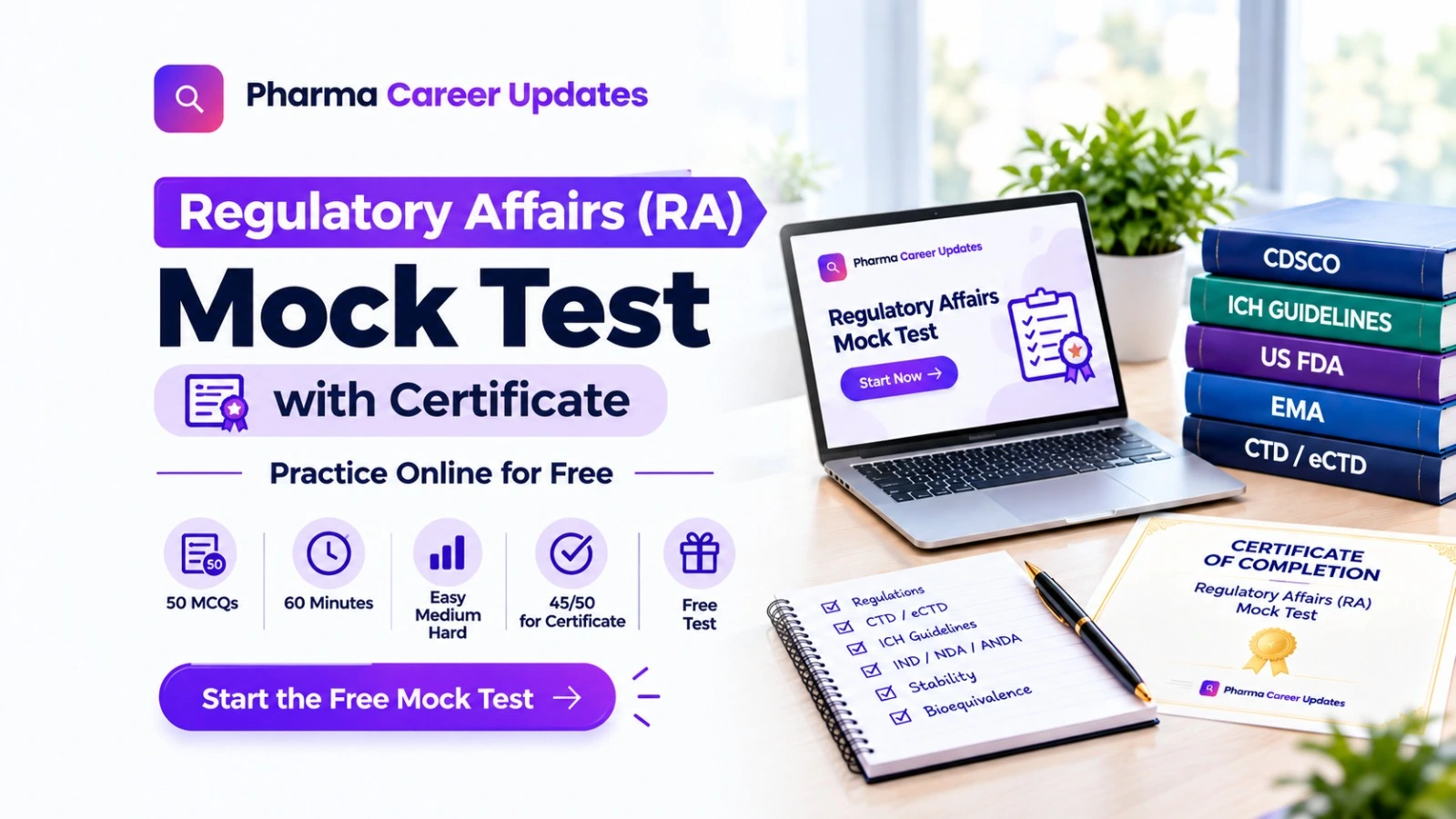
Regulatory Affairs (RA) Mock Test with Certificate – Practice Online for Free Published on: October 23,… Read More
Free Pharma Mock Tests
Test yourself on the subjects that matter for GPAT, pharmacist and pharma job exams.