Regulatory Affairs (RA) Mock Test with Certificate – Practice Online for Free
Regulatory Affairs (RA) Mock Test with Certificate – Practice Online for Free Published on: October 23,… Read More
Published on: October 27, 2026
If you’re a pharmacy, life science or nursing graduate, someone has probably told you, “Try medical coding.” It sounds simple until you open a code book and see thousands of codes, strange rules and abbreviations you’ve never met.
Coming from a pharmacy background and wondering whether coding is a realistic fit? Our guide on medical coding after B.Pharm covers eligibility, skills and career growth in detail.
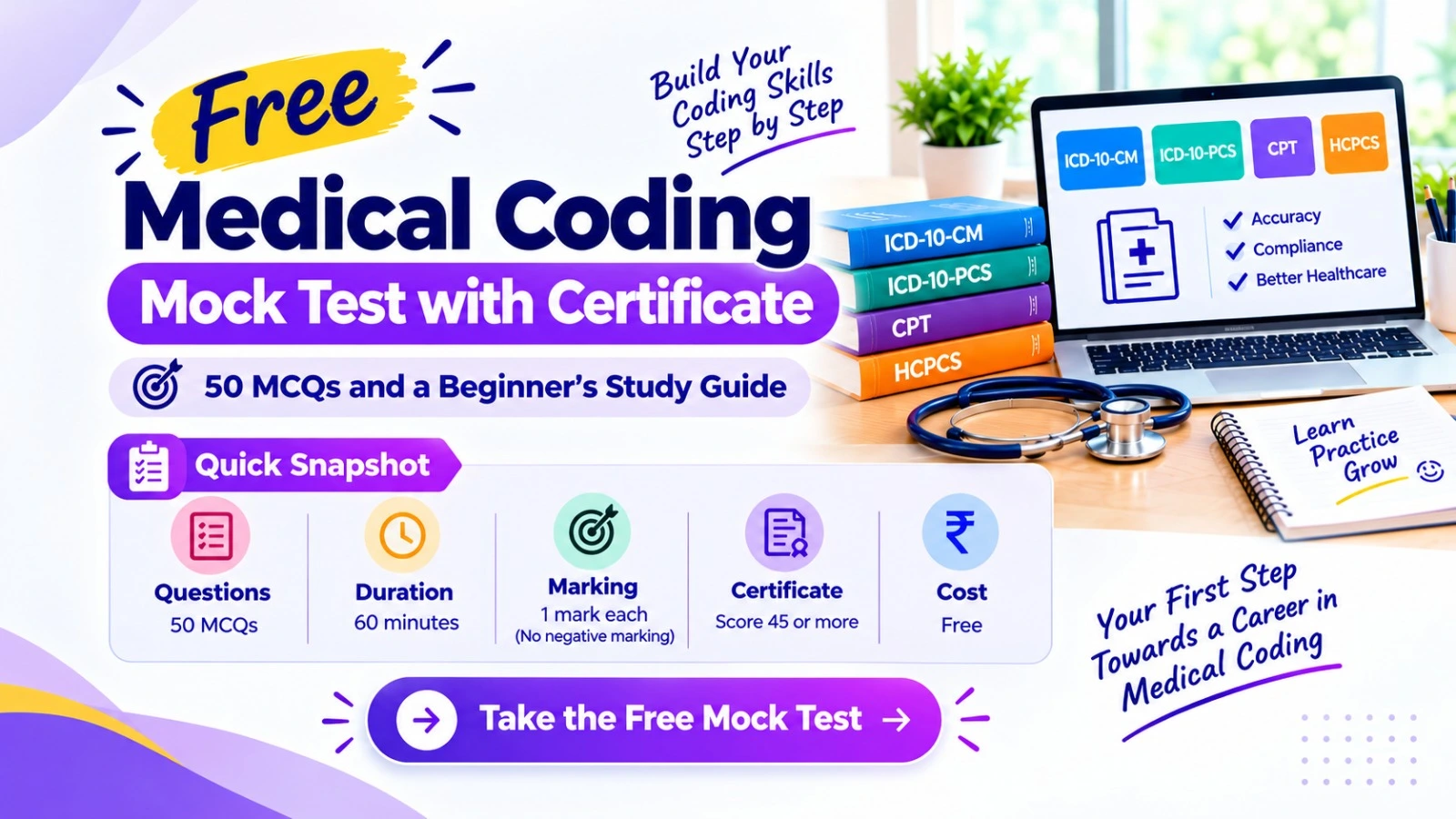
Quick snapshot
| Detail | Info |
|---|---|
| Questions | 50 MCQs |
| Duration | 60 minutes |
| Marking | 1 mark each, no negative marking |
| Certificate | Score 45 or more |
| Cost | Free |
👉 Take the Free Medical Coding Mock Test
When a doctor treats a patient, the details go into clinical notes. A medical coder reads those notes and converts them into standard codes. Hospitals and clinics use these codes to bill insurance companies, keep records and track health data.
| Code set | What it describes | Simple example |
|---|---|---|
| ICD-10-CM | The diagnosis (why the patient needed care) | Type 2 diabetes |
| ICD-10-PCS | Inpatient hospital procedures | A surgical procedure during admission |
| CPT | Services and procedures a provider performed | An office visit, an X-ray |
| HCPCS Level II | Supplies, equipment and certain drugs | An injectable drug, a wheelchair |
A bit of background: ICD is the World Health Organization’s International Classification of Diseases, and ICD-10-CM is the US clinical modification of it, published through the CDC. CPT is developed by the American Medical Association, and HCPCS Level II is maintained by CMS.
Coding rewards attention to detail more than anything else. If you can read documentation carefully and follow rules consistently, you can learn it.
| Section | Difficulty | Questions | Marks |
|---|---|---|---|
| Section A | Easy | 15 | 15 |
| Section B | Medium | 20 | 20 |
| Section C | Hard | 15 | 15 |
| Total | 50 | 50 |
You also get:
A quick honest note: the certificate is a practice achievement from our website. It is not an official coding credential, but it’s a handy way to show you’ve practiced and to track your progress.
| Topic | What to revise |
|---|---|
| ICD-10-CM | Structure, chapters, placeholder X, 7th characters, Z codes, Excludes notes |
| ICD-10-PCS | 7-character codes, sections, body systems, root operations |
| CPT | Category I, II and III codes, section ranges |
| Modifiers | 25, 26, 50, 51, 59 and TC |
| HCPCS, DRG and billing | Level II codes, MS-DRGs, MCC and CC, claim forms, NCCI edits |
| Terminology and compliance | Prefixes, suffixes, HIPAA, CMS, outpatient vs inpatient rules |
CPT codes are grouped by type of service. Knowing the ranges helps you spot the right section quickly. The AMA also offers free introductory CPT courses if you want a deeper look at how the code set is structured.
| Section | Code range |
|---|---|
| Evaluation and Management | 99202–99499 |
| Anesthesia | 00100–01999 |
| Surgery | 10004–69990 |
| Radiology | 70010–79999 |
| Pathology and Laboratory | 80047–89398 |
| Medicine | 90281–99607 |
Modifiers add detail to a code without changing its basic meaning.
| Modifier | Meaning |
|---|---|
| 25 | Significant, separately identifiable E/M service on the same day as a procedure |
| 26 | Professional component only (the physician’s interpretation) |
| TC | Technical component only (equipment and staff) |
| 50 | Bilateral procedure |
| 51 | Multiple procedures in one session |
| 59 | Distinct procedural service (needs documentation to support it) |
The rules below come from the ICD-10-CM conventions and the ICD-10-CM Official Guidelines for Coding and Reporting, published by CMS and the National Center for Health Statistics. The link is the current FY 2027 edition, effective October 1, 2026. The guidelines are free to read, and every serious coder should go through them at least once.
| Rule | What it means |
|---|---|
| Code length | 3 to 7 characters, with a decimal after the third |
| 7th character A | Initial encounter (injury codes) |
| 7th character D | Subsequent encounter |
| 7th character S | Sequela |
| Placeholder X | Fills empty characters so the 7th character lands in the 7th position |
| Excludes1 | Generally, don’t report the two conditions together |
| Excludes2 | The two conditions can be reported together |
| NOS | Not otherwise specified |
| NEC | Not elsewhere classifiable |
If a diagnosis is documented as “probable,” “suspected” or “rule out”:
| Setting | What you do |
|---|---|
| Outpatient | Don’t code the uncertain diagnosis. Code the signs and symptoms instead. |
| Inpatient | You may code it as though it were confirmed. |
Patient privacy is a big part of compliance work. In the US, it’s governed by the HIPAA Privacy Rule, which sets national standards for protecting health information.
| Term | Meaning |
|---|---|
| CMS-1500 | Professional claim form |
| UB-04 | Institutional (hospital) claim form |
| MS-DRG | Groups inpatient stays for payment |
| MCC / CC | Major complication or comorbidity / complication or comorbidity |
| Upcoding | Billing a higher-paying code than the service delivered |
| Unbundling | Billing separately for services that should be reported together |
| No. | Question | Answer |
|---|---|---|
| Q1 | A doctor documents “suspected pneumonia” in an outpatient visit. What do you code? | The symptoms, such as cough or fever |
| Q2 | Which CPT section does a chest X-ray fall under? | Radiology |
| Q3 | A radiologist only interprets an image taken elsewhere. Which modifier fits? | 26 (professional component) |
| Q4 | What does the 7th character “D” mean in an injury code? | Subsequent encounter |
| Q5 | Can two conditions with an Excludes1 note be coded together? | Generally no |
If you got four or five right, you’re in good shape. If not, no problem. That’s exactly what practice is for.
| Days | Focus |
|---|---|
| 1–3 | Medical terminology (prefixes, suffixes, body systems) |
| 4–6 | ICD-10-CM guidelines and conventions |
| 7–9 | CPT sections and modifiers |
| 10–11 | HCPCS, DRGs, claim forms and compliance |
| 12 | Take the mock test and read every explanation |
| 13–14 | Revise weak areas, then retake the test |
| Mistake | What to do instead |
|---|---|
| Coding from the alphabetic index alone | Always confirm the code in the tabular list |
| Skipping the official guidelines | Read them, since many answers depend on them |
| Coding “rule out” diagnoses in outpatient cases | Code the symptoms |
| Using modifier 59 as a shortcut | Use it only with proper documentation |
| Memorising without understanding | Learn why a rule exists |
Don’t rely on any single website, including ours. These are the official sources the coding world itself uses:
| Resource | What you’ll find there |
|---|---|
| ICD-10-CM Official Guidelines (CDC/NCHS) | The free, official rules for diagnosis coding |
| CDC: ICD-10-CM | Code sets and background on ICD-10-CM |
| WHO: International Classification of Diseases | The global classification that ICD-10-CM is based on |
| AMA: CPT | Background on CPT, which the AMA develops and maintains |
| AMA: Free CPT Online Courses | Short introductory courses on CPT structure and categories |
| CMS: HCPCS | Official information on HCPCS Level II codes |
| HHS: HIPAA Privacy Rule | Official guidance on protecting patient information |
A mock test shows you where you stand, but it doesn’t replace proper training. If you want to pursue coding as a career, look into recognized certifications:
| Certification | Issued by | Good to know |
|---|---|---|
| CPC (Certified Professional Coder) | AAPC | Widely recognized for professional (physician-office) coding |
| CCS (Certified Coding Specialist) | AHIMA | Mastery-level credential, usually hospital-based coding |
Eligibility rules, fees and exam formats change, so always check the official AAPC and AHIMA pages before you plan. Certification requirements also differ from one employer to another, so check what the job you want actually asks for. Code sets are updated regularly too, so study from the current year’s official guidelines and code books.
| Question | Answer |
|---|---|
| Is this mock test free? | Yes. The test, explanations and certificate are free. |
| Is there negative marking? | No. Attempt every question. |
| Can pharmacy or nursing students take it? | Yes. Anyone interested in medical coding can take it. |
| Can I retake the test? | Yes. Questions and options are shuffled each time. |
| Will this guarantee me a job? | No. It’s a practice tool to build knowledge and confidence. Job opportunities depend on your skills, training and the employer’s requirements. |
Set aside an hour, keep some rough paper handy, and take the test without peeking at notes. Then read the explanations carefully. That’s where most of the learning happens.
👉 Start the Free Medical Coding Mock Test
Career guides for B.Pharm graduates
| Read next | What you’ll learn |
|---|---|
| Medical Coding After B.Pharm | Eligibility, skills, salary and career scope |
| Career Options After B.Pharm | Other paths you can compare |
| Career in Quality Assurance (QA) After B.Pharm | What QA roles involve |
| Career in Regulatory Affairs After B.Pharm | What RA roles involve |
| Government Jobs After B.Pharm | Public-sector options |
More free mock tests
| Mock test | Link |
|---|---|
| Regulatory Affairs (with certificate) | Regulatory Affairs Mock Test |
| Pharmaceutics | Pharmaceutics Mock Test |
| Pharmacology | Pharmacology Mock Test |
| Quality Assurance | Quality Assurance Mock Test |
| Pharmacovigilance | Pharmacovigilance Mock Test |
| All subjects | Free Pharma Mock Tests |
Explore more on Pharma Career Updates
Disclaimer: This article is for educational and practice purposes only. We are not affiliated with AAPC, AHIMA, the AMA, WHO, CMS, CDC or HHS. Always refer to the current official coding guidelines and code books for accurate coding.
Regulatory Affairs (RA) Mock Test with Certificate – Practice Online for Free Published on: October 23,… Read More
Free Pharma Mock Tests: Practice Online with Instant Scores and Certificate Published on: October 16, 2026… Read More
Free Pharma Mock Tests
Test yourself on the subjects that matter for GPAT, pharmacist and pharma job exams.